
Will Robotics Be The Game Changer?
- Karmit Goswami
- Apr 8, 2022
- 2 min read

The constant quest for innovation to provide agility to the manufacturing industry that reduces production cost while increasing the precision and effectiveness has given rise to a new breed of machines, the industrial robots.
The industrial robots and their applications are manifold; they not only perform the repetitive tasks with a precision that can be tedious for a human and without mistake, but they also maintain the speed and consistency. Thus upholding the quality of the product.
The industrial robots and their applications have made them the highly coveted machines in the manufacturing industries like automotive, electronics, metals, chemicals, and food. In 2017 industrial robots sales reached the highest and it is estimated to reach at least 15% increase on average per year until 2020.
Industrial 4.0 is another factor that will result in robots being the game changer in the future. So what are the emerging trends that might answer the question will robots be a game changer in the future?
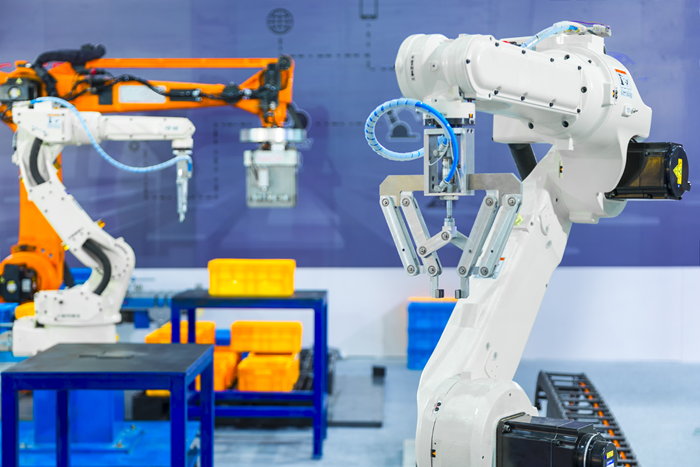
Types of Industrial Robot :
Based on the mechanical structure the robots can be classified as per the International Federation of Robotics. The following articulated robots have been accounted for the maximum share in the industrial robotics. These are the most functional industrial robots that have been extensively used in healthcare and packaging sectors.
Articulated Robots : This robot has rotatory joints in its design, which can have from a couple of simple joints to 10 or more. These are generally used for metal casting, welding, palletizing, and painting.
SCARA Robots : This robotic arm is typically cylindrical in design and is commonly used for assembly and packaging applications.
Linear/Cartesian Robots : These have three linear joints in its design and are also called rectilinear or gantry robots. Cartesian robots are typically formed with the Cartesian coordinate system X, Y, and Z. They are generally used for laser welding, pressing, sealing, and handling of plastic molding.
Parallel Robots : These are spider-shaped robots that have jointed parallelogram that is connected to a common base. The typical functions of this industrial robot is picking and placing, assembling, and handling and are hence used in the food, pharmaceutical, and electronic industries.
Polar : This robot has quite a few joints in its design with the arm connected to the base with a twisting joint while having two rotary joints and a linear joint. The polar robot is also known as the spherical robot that is used in picking and placing, handling, and assembly.
Cylindrical : This robot has a minimum of a prismatic joint that connects the links and a minimum of a rotary joint at the base.
In the coming years, the fact that robotics will change how the industries operate is a redundant statement. Rather it will be interesting to see what changes it will bring about with robots already becoming an active part in the everyday operation of the businesses and they are being used to interact with the customers.

Comments